

Great balls of fire!
Sydney Gazette, Sunday, January 22, 1809
“Between three and four in the afternoon of Sunday last, a genteel pleasure party, at South Head consisting of 14 Officers and Ladies, experienced one of the most general as well as violent electric shocks that perhaps ever was experienced.
The company were preparing to take a cold collation beneath a fig tree; and from the threatening aspect of the weather, intended to make no further delay; several reports of very distant thunder had been heard, but no lightning was yet discernible; when on a sudden a tremendous crash near to where they sat took place, occasioned by an immense ball of fire striking a rock not very distant from the tree, and rending it completely; then glancing towards the sea, threw up a prodigious body of water by its immersion.
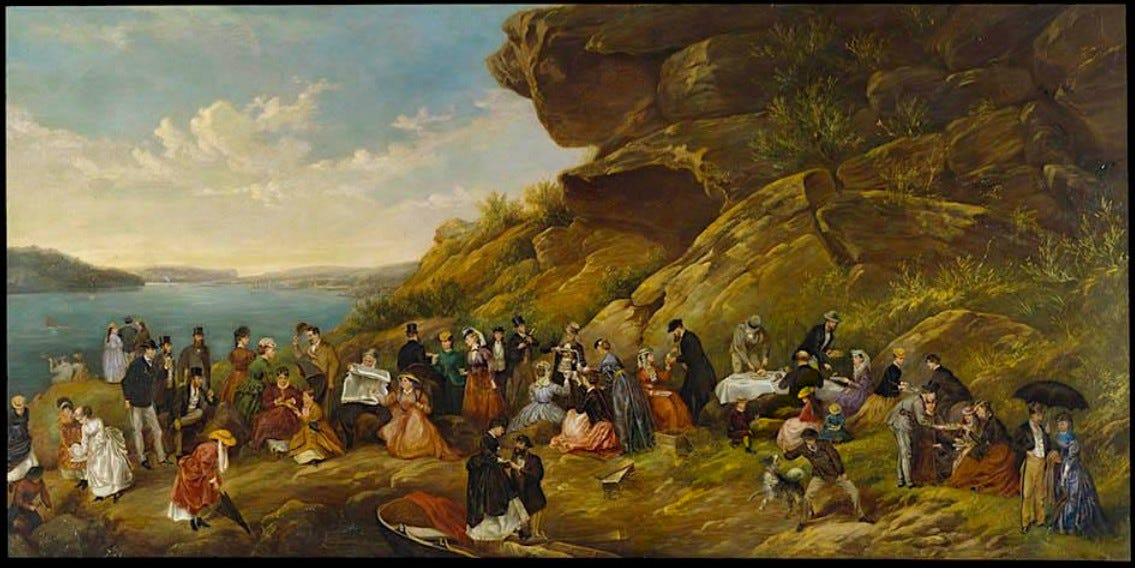
The consequences of this surprising phenomenon were nearly fatal to the whole of the above company; a part of the electric fluid being probably attracted by the knives and forks on the table, took its course that way, and at the same instant ten of the company were struck down, some to all appearance dead, and others strangely affected by delirium.
Captain Porteus sensibly felt the shock, but, happily, was not otherwise affected; Mr. Harris was knocked down, and supposed to have been killed, but soon recovered; on the right temple the hair were singed, and his right side and thigh were bruised severely; Mr Sloan was also knocked down, and remained some days in a dangerous and doubtful state; his breast and arm were singed, and much bruised; Lieutenant Laycock received the shock on the right side, and was much lamed; Mr. G. Blaxland had a bottle knocked out of his hand, but escaped hurt.
The principal sufferer, however, was a young Lady, whose head was in a total blaze, and who must have perished in a state of insensibilty had not assistance been at hand.
The fire was extinguished by Mr. Blaxland; but no hope of her surviving could be entertained.
-- She has nevertheless since recovered her faculties; and out of the whole number that felt this tremendous shock, it is a truly gratifying reflexion, that no single individual is likely to bear any lasting mark of its excessive violence.”
Lightning strikes twice
In February 2024, lightning struck a group of people sheltering under a tree at the Botanic Gardens, Sydney, just after 1pm. Four people were knocked unconscious and taken to hospital with burns.
Six ambulances rushed to the scene where paramedics tended to the group including a teenage male, a woman in her 20s, and a man and woman in their 30s.
That is how news is reported these days. BORING.
But in 1809, when the British colony was about to turn 21, lightning struck at Sydney’s South Head. Enjoy The Sydney Gazette - they knew how to report.
Brave Mr Blaxland
Brave Mr Blaxland, putting out the lady’s hair. That could have been either young Gregory Blaxland, then-aged 20, who went on to explore the Blue Mountains with Lawson and Wentworth, or his older brother John Blaxland, who energetically petitioned for the right to trial by jury for the colony.
The federal seat of Blaxland in Sydney’s southwest was named after Gregory. It has been colonised by Islam since the 1980s and is now 31.7 percent Muslim as of the 2021 Census.
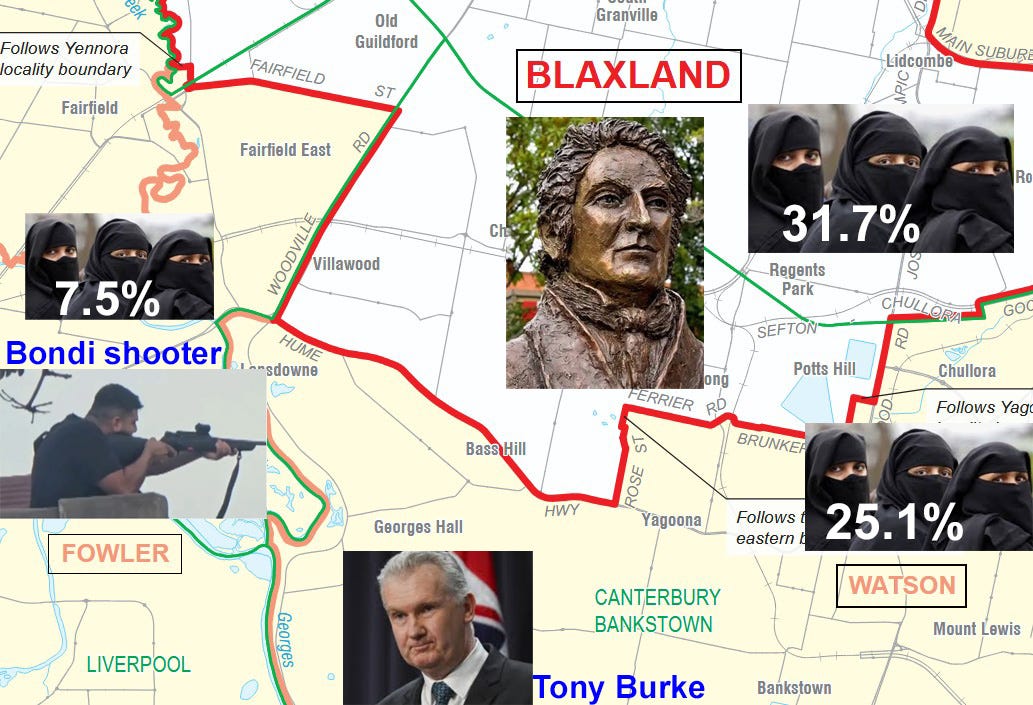
Blaxland borders Immigration Minister Tony Burke’s seat of Watson, which was 25.1 percent Islamic as of the Census, and the seat of Fowler (7.5%), which contains the Bonnyrigg home of Islamist shooters Sajid and Naveed Akram, who murdered 15 people at Bondi in December.
Labor MP Jason Clare now holds the seat of Blaxland. Alongside Tony Burke, he voted for censorship laws on January 20, sold as a response to the Bondi shooting. In reality they punish anyone who criticises the Islamic State ideology of the shooters and enable further Islamist expansion.
What would the Blaxland brothers have said about that?
Smallpox vaccine attempt didn’t work
Sydney Gazette, Sunday, May 29, 1803
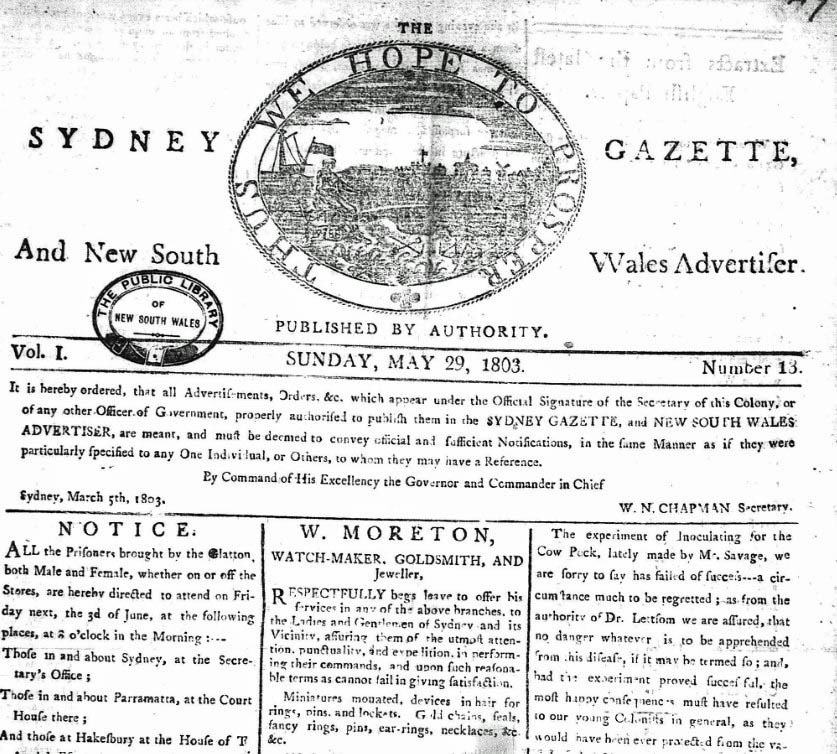
“The experiment of Inoculating for the Cow Pock, lately made by Mr. Savage, we are sorry to say has failed of success - a circumstance much to be regretted; as from the authority of Dr. Lettsom we are assured, that no danger whatever is to be apprehended from this disease, if it may be termed so; and, had the experiment proved successful, the most happy consequences must have resulted to our young Colonists in general, as they would have been ever protected from the variolous infection, to which, uncounted numbers fall victims throughout Europe, and from whose dreadful contagion our remote situation hitherto secures us.”
It wasn’t just Edward Jenner
Edward Jenner is widely credited for inventing the smallpox vaccine in 1796 by scratching cowpox into the arm of eight-year-old James Phipps.
It wasn’t a new idea.
People had been experimenting with variolation for centuries.
“Variolation” was simply “vaccination” but with live smallpox virus instead of cowpox.
It was practiced in China, India, and Africa before being brought to London from the Ottoman Empire by Lady Mary Wortley Montague in 1721, history here.
In 1803, the Australian colonists also tried. But they failed. It didn’t work. They tried a lot of things. It was a very difficult time.
Distance didn’t save them from smallpox
The first smallpox outbreak occurred in 1789 immediately after the colony was first established, and it devastated Aboriginal people.
The British colonists all had some immunity from childhood exposure, but the Aborigines had been isolated for 60,000 years and had no immunity, as Australian Geographic reports.
It is not known how Aboriginal people got infected, but one possible route was the practise of trying to use small amounts of live smallpox to innoculate children, by variolation.
For centuries, people had used pus or dried scabs from a person with a mild case of smallpox to innoculate children via their skin or nose.
Surgeon John White had brought variolous matter in a sealed glass bottle on the First Fleet in order to variolate children born in the settlement.
It is possible they tried to help Aboriginal children by variolating them, although there is no record of this.
The early colonists blamed the French. French explorer Comte de La Perouse had also arrived in January 1788 and anchored his ships in Botany Bay for six weeks for replenishment. During that time one of his company died, and was buried.
The smallpox virus remains infective for years when embedded in dried scabs and so it may have been brought in on a scab caught up in cotton, bedding or clothing. Both the British and the French were keen to trade goods with the natives.
Recent attempts to accuse the British of deliberately infecting Aboriginal people are malevolent, motivated and without evidence.
In 1788, the colonists were trying their best to make friends with the natives and to build a good place to live.
An 89cm pumpkin
Sydney Gazette, Sunday, August 14, 1803
“A Pumpkin was some short time since cut at the Hawkesbury which measured 35 inches (89cm) In length. Its species is a native of Rio de Janeiro, sometimes yields abundantly, but generally tender and difficult to rear.”
Food is life
A large part of the first Australian newspaper was devoted to how to grow food. Everyone was encouraged to learn about how to make compost from “night soil”, how to grow grapes, or what might be the right breeds of cattle and sheep for the climate.
When the first peach tree in Australia flowered in Sydney, it made the paper.
Food was also the most attractive thing about the new colony for Aboriginal people who had never seen these species before, or European methods of farming food.
Women fighting in the streets
Sydney Gazette, Sunday, August 14, 1803
“On Sunday last a quarrel took place on the Rocks between a number of women, who separated into two divisions, and came to action rank and file.
The noise attracted the notice of the Police, who secured a dozen of the Amazons, and one sturdy fellow, who took an active part in the contest, and acted as generalissimo to both armies.
On Monday a complaint was preferred to the Magistracy, when the parties were severely reprimanded, but humanely permitted to return to their respective avocations, upon a promise of future good behaviour.”
Aborigines throw spears in Pitt St, tug-of-war over dead man’s wife scandalises the colony
Sydney Gazette, Sunday October 16, 1803
“On Sunday last a number of Natives assembled on a ground at the upper end of Pitt’s Row, with a design of inflicting punishment on two men who were directly or indirectly concerned in the assassination of two others who died of their spear wounds.
About an hour before sun‐set the parties made their appearance, and were received by their friends and partizans, who presented each with a target or Coolemon, as a defence against the missile assaults of their adversaries, who instantly arose and approached the intended victims of an ungovernable antipathy and rage.
One of these, known to us by the name of Musquetto, was the first assaulted, and he with surprising dexterity defended himself against 64 spears, all thrown with rancour and malignity, and 17 of which went through the target, some to a depth of nearly two feet.
The 65th and last thrown at him entered the calf of his right leg, and penetrated six inches through.
The spear, which measured more than eight (?). This was cut short before it could be extracted. At the other only nine (spears) were launched, all which he avoided.
A contest afterwards took place between two opposite parties for the wife of one of the deceased.
The exercise of merciless barbarity on this and similar occasions strongly characterizes this wretched race of men, who, but for their barbarous and irreconcileable usages in cases of homicide, would wholly extirpate their already thin and scattered handfuls.
After receiving many severe blows from either party, and having her arms almost dragged from their sockets, the unfortunate ꜰᴀɪʀ (lady) was borne in triumph from the field by an Hibernian Taylor (Irish tailor - Hibernia was the Roman name for Ireland), who probably could sympathise in the sufferings of an unhappy fellow‐creature, notwithstanding all the difference of complexion.”
This story is uploaded to Trove, here.
Wild times in the new colony
Can you imagine trying to cut homes and roads from the rocky scrub - with no power tools, no refrigeration and no going back.
You didn’t know the land, or what was good to eat. There were native people and you had to make friends with them for your own survival, but you didn’t speak their language and their culture was bewildering and often violent.
You had to carve a built environment. You had to dig wells: if you left the cover off, people fell in. Carve stone. Grow food. Dig sewers. Build bridges. Survey the land. Make a parliament, a treasury, a mint, a newspaper.
This was not easy. But the British managed to build the foundations of modern Australia, and they were sturdy.
It was not an invasion, as liars tell children. It was a settlement colonisation.
Everyone brought something to build Australia.
Aboriginal people effectively traded land for a built environment and technology they previously did not have, such as running water and readily available food.
The colonists brought the built environment, agriculture, the social and political structure. All subsequent migrants slotted into this structure. Their efforts helped grow the nation, but the foundations were laid by the British starting on January 26, 1788.
Without them, there would be no Australia.
We should never change the date. No need to protest: just celebrate.
For more wild tales of the colony, see last year’s collection below, including the tale of Daniel Moowattye, the Parramatta lad who went to London.
AUSTRALIA DAY: Wild tales from the colony

A couple of wild stories from Australia’s first newspaper, the Sydney Gazette, from when the colony was just 15 years old on plus some other interesting tidbits. I will update with pictures and details and new stories as I have time.
Australia’s most racist council: City of Sydney
City of Sydney Council has once again snubbed Australia’s British colonial heritage despite 26 January marking the very first origin of the city.
Two years ago Lord Mayor Clover Moore described Sydney as the “first site of invasion”, and stripped a colonial-era flag from a council office as City Hub reports.
Last year, it gave $2 million to celebrate Chinese New Year over 19 days of Lunar festivities, decking the city in red street banners and bus-stop ads while ignoring Australia Day. Not one penny went to celebrate the colony. Money went instead to the Yabun Aboriginal festival, which promoted hating Australia as “200 years of violent colonial dispossession”.
This year, there are no red Lunar New Year street banners. Council did not say whether they were again handing millions to the Chinese festival.
The main drag up William St and past Hyde Park had no street banners at all on Friday night.
Letters From Australia sent a prickly request to City of Sydney, to ask if they would support any commemoration of our British colonial history on Australia Day, but they did not say. Because they aren’t.
Instead, a spokesperson said via email that they were supporting Yabun and “Australia Day events” organised by the Australia Day Council of NSW. That includes the Harbour ferry race, the Tall Ships race, some fireworks, a music concert and several more Aboriginal events like the dawn reflection.
The spokesperson also said they would host a citizenship ceremony for 200 people on 27 January.
That’s the day after Australia Day. That is to show how proud they are of infinity migration from everywhere in the world, except for Britain in 1788.
Everyone’s heritage is important to them.
Snubbing Australia day as “Invasion Day” is racist. It’s about destroying Australia, and it’s paid for by your taxes through arts funding grants.
None of this is the fault of Aboriginal people, most of whom consider themselves Australians. They don’t want this divisive and separatist nonsense.
To see stories on the previous Australia Day attacks, see the links below.


Good stuff. Real history is so much more interesting than the pap currently being peddled by the Clover Moores of this world.
Good write up, but it is sad to still see people confusing Australia Day with colonial times, IT IS NOT.
Australia Day, 26th January 1948, was the granting of “Australian Citizenship” to Australians so we could travel on an Australian passport rather than as an English Subject.
"On 26 January 1949, the Nationality and Citizenship Act 1948 became law. It was the first time that the term ‘Australian citizen’ had been used in any Australian legislation, including the Australian Constitution. Although the Act has been changed since 1948, it is still the basis for how a person becomes an Australian citizen.”
Wikipedia is INCORRECT and labels Australia Day as the Invasion Date. (typical for Wikipedia now sadly, just a globalist propaganda tool.